Conferences

Tagung-Opava-Call-for-Participation

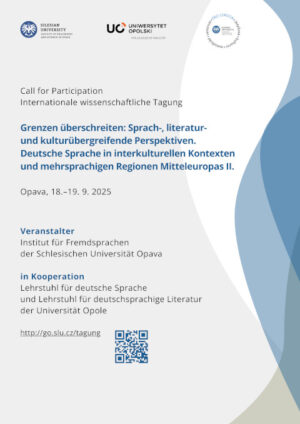
Crossing Boundaries: Cross-linguistic, cross-literary and cross-cultural perspectives. The German language in intercultural contexts and multilingual regions of Central Europe II

When: 18–19 September 2025

Where: Institute of Foreign Languages, Silesian University, Opava

We warmly invite you to join us in reflecting on the current state, past and future of German studies and the German language in the Czech Republic, Poland and other Central European countries. This conference follows the 2024 conference in Opole and aims to shed light on the practical challenges posed by globalisation, for example in the education system, the world of work or cross-border cooperation.


The following topics will be the focus of attention:

  1. Multilingualism in Central Europe – dynamics, challenges and prospects.
  2. Linguistic innovation – dynamics, influencing factors and social significance.
  3. Globalisation and literature and cultural studies – narratives, perspectives and cultural dynamics.
  4. Foreign language teaching in response to globalisation and social, political and cultural changes in the 21st century.
  5. The future of translation studies in the context of the rapid development of artificial intelligence.
  6. Cooperation between German studies and the business sector – potential, challenges and prospects.

In parallel with the academic sessions, the conference will be accompanied by a ‘round table’, that will provide an opportunity for an exchange of views between representatives of academia and business. The most important practical aspects of cooperation between German studies (Silesian University in Opava and the University of Opole) and representatives of business, associations and organisations, as well as schools in the Silesian region, will be discussed here. Particular emphasis has been placed on the promotion of the German language. Cooperation with companies, businesses and public institutions is particularly important for developing practical solutions and for effectively integrating multilingualism into the requirements of a globalised world of work, as well as for maintaining and promoting the German language not only as an important means of communication, but also as part of the cultural heritage of Silesia and Central Europe in general.


Alongside the academic sessions, the conference will be accompanied by workshops for German language teachers.


[VISIT THE CONFERENCE WEBSITE]


[SEE MATERIALS: INVITATION and PROGRAMME, ROUND TABLE and PROGRAMME]

MiOKO23

23rd International and National Onomastic Conference

When: 19–21 October 2023

Where: University of Opole, Collegium Maius, 11 Kopernika Square

The regular International and National Onomastic Conference always provides an opportunity for onomasticians from Poland and abroad (from both Slavic and non-Slavic countries) to exchange experiences. Subsequent meetings address the most current linguistic issues concerning both theoretical aspects and empirical research.

We have chosen Cultural Onomastics as the theme of our upcoming conference. In recent years, there has been a shift in onomastics towards interdisciplinary research, which views language as a reflection of historical, political and cultural processes. Onomastics, like cultural linguistics, falls within the field of anthropological linguistics, which is founded on the belief in the cultural nature of language – a source of knowledge about how humans think about the world. Moving away from an autonomous view of language and the description of language for its own sake, it opens up a broader field of interest for the researcher.

The conference focused on the following research issues:

  • the cultural turn in onomastic studies; the methodology of cultural onomastic studies; proper names in the light of ethnolinguistics, cultural and anthropological linguistics, and the linguistic worldview;
  • proper names at cultural, ethnic, linguistic, religious and geographical boundaries;
  • a cognitive approach to onymy: the perspective of the creator and user of a name; proper names as carriers of values; the categorisation and classification of proper names; stereotypes and naming;
  • names of specific referents in different cultures and languages;
  • proper names in discourse; secondary functions of proper names: including culture-forming, ludic, pragmatic, marketing and persuasive;
  • proper names and cultural products: comics, film, music, books, posters, art, fashion, etc.

[SEE THE CONFERENCE ARCHIVE PAGE]

The regular International and National Onomastic Conference always provides an opportunity for onomasticians from Poland and abroad (from both Slavic and non-Slavic countries) to exchange experiences. Subsequent meetings address the most current linguistic issues concerning both theoretical aspects and empirical research.

We have chosen Cultural Onomastics as the theme of the upcoming conference. In recent years, there has been a shift in onomastics towards interdisciplinary research, viewing language as a mirror of historical, political and cultural processes. Onomastics, like cultural linguistics, falls within the field of anthropological linguistics, which is founded on the belief in the cultural nature of language – a source of knowledge about how humans think about the world. Moving away from an autonomous view of language and the description of language for its own sake, it opens up a broader field of interest for the researcher.

The conference focused on the following research issues:

  • the cultural turn in onomastic studies; the methodology of cultural onomastic studies; proper names in the light of ethnolinguistics, cultural and anthropological linguistics, and the linguistic worldview;
  • proper names at cultural, ethnic, linguistic, religious and geographical boundaries;
  • a cognitive approach to onymy: the perspective of the creator and user of a name; proper names as carriers of values; the categorisation and classification of proper names; stereotypes and naming;
  • names of specific referents in different cultures and languages;
  • proper names in discourse; secondary functions of proper names: including culture-forming, ludic, pragmatic, marketing and persuasive;
  • proper names and cultural products: comics, film, music, books, posters, art, fashion, etc.

[SEE THE CONFERENCE ARCHIVE PAGE]

KJS_Konferencja Języki słowiańskie w ujęciu diachronicznym i synchronicznym 1

1st International Scientific Conference in the series Slavic Languages in Diachronic and Synchronic Perspectives, entitled Between History and the Present

When: 18–19 May 2024

Where: University of Opole, Collegium Maius, 11 Kopernika Square

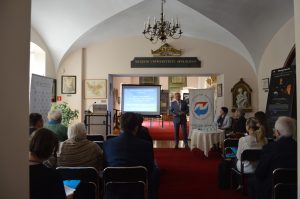
The conference, organised by the Department of Slavic Languages at the University of Opole, marks the start of a series of meetings aimed at scholarly reflection on current issues in Slavic linguistics. The subject of the research encompasses all Slavic languages, which are examined from diachronic, synchronic and comparative perspectives. We propose a discussion on the linguistic and cultural heritage of the Slavic world and the history of individual Slavic languages, as well as their contemporary situation, their functioning in multicultural and multi-ethnic contexts, as well as their prospects for development, and on Slavic discourses of identity and religion, particularly at ethnic, cultural and linguistic borders.

During the conference, academic reflection was undertaken on the following specific issues:

  1. Diachronic studies of Slavic languages.
  2. Current status and trends.
  3. Lexicographical description of Slavic languages.
  4. The linguistic and cultural worldview of the Slavs.
  5. Slavic theolinguistics.
  6. New directions in Slavic linguistics.
53646955645_1e7c8147cc_c

Crossing boundaries: Cross-linguistic, cross-literary and cross-cultural perspectives. The German language in intercultural contexts and multilingual regions of Central Europe

When: 11–12 April 2024

Where: University of Opole, Collegium Maius, 11 Kopernika Square

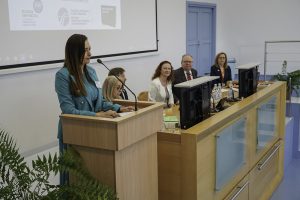
The international academic conference focused on crossing boundaries in language, literature and culture, as well as the significance of the German language in intercultural contexts and in the multilingual regions of Central Europe. The conference was organised by the Department of German Language and the Department of German-Language Literature at the University of Opole, in collaboration with the Institute of Foreign Languages at the Silesian University in Opava (Czech Republic) and the Department of German Linguistics at the University of Erfurt (Germany). The conference was attended by 61 speakers from Germany, the Czech Republic, Slovakia, Hungary, Croatia, Italy, Sweden, Ukraine and Poland, representing renowned academic and teaching institutions, including those in Budapest (Hungary), Berlin, Erfurt, Frankfurt (Oder), Eichstätt, Würzburg (Germany), Košice (Slovakia), Bolzano (Italy), Kristianstad (Sweden), Prague, Opava, Ostrava (Czech Republic), Drohobych (Ukraine), Osijek (Croatia), Gdańsk, Kraków, Olsztyn, Poznań, Piła, Racibórz, Rzeszów, Katowice, Łódź, Szczecin, Warsaw, Wrocław, Nysa and Opole.

An important event accompanying the conference was a ‘round table’ debate involving representatives from business, business support institutions, local government, education and the academic community on the role of the German language in the economic development of the Opole Province. Conference participants also took part in the debate.

The lectures presented, as well as the discussions held during the plenary sessions, section meetings, workshops and the round table, along with informal discussions, allowed not only an introduction to the results of the latest research, but also the exchange of teaching and academic experiences. The conference thus became an important platform for academic exchange and a starting point for establishing and intensifying academic cooperation and intercultural contacts. Students also took part in the proceedings.

The conference was made possible thanks to the financial support of the Foundation for Polish-German Cooperation.

[SEE PHOTO REPORT]

Skip to content